7 Common Communication Challenges in Growing Businesses and How to Solve Them

The thrill of scaling a company is exhilarating; however, it is also the time when we begin to see the cracks that exist in the foundation of the company. For instance, the way a company runs effectively with 5 employees working together in one small office can be very different from 50 employees spread out over multiple time zones. Dealing with common communication challenges becomes a necessity as the ability to do a quick “desk-side” meeting is eliminated and hindering difficulties surface.
Numerous business communication difficulties have surfaced, thus hindering ongoing growth for each of us individually and towards the company as a whole. If you think your group has been continuously playing a game of ‘telephone’, meaning that sending information has not reached the intended recipient, you are not the only one!
Growth creates increased complexity for all growing organizations; however, the difference between an organization that levels off (plateaus) and grows (continues to thrive) is based on how well they overcome their communication gaps.
This article will identify some of the top 7 challenges that businesses face when trying to grow and provide actionable solutions and strategies to overcome these challenges.
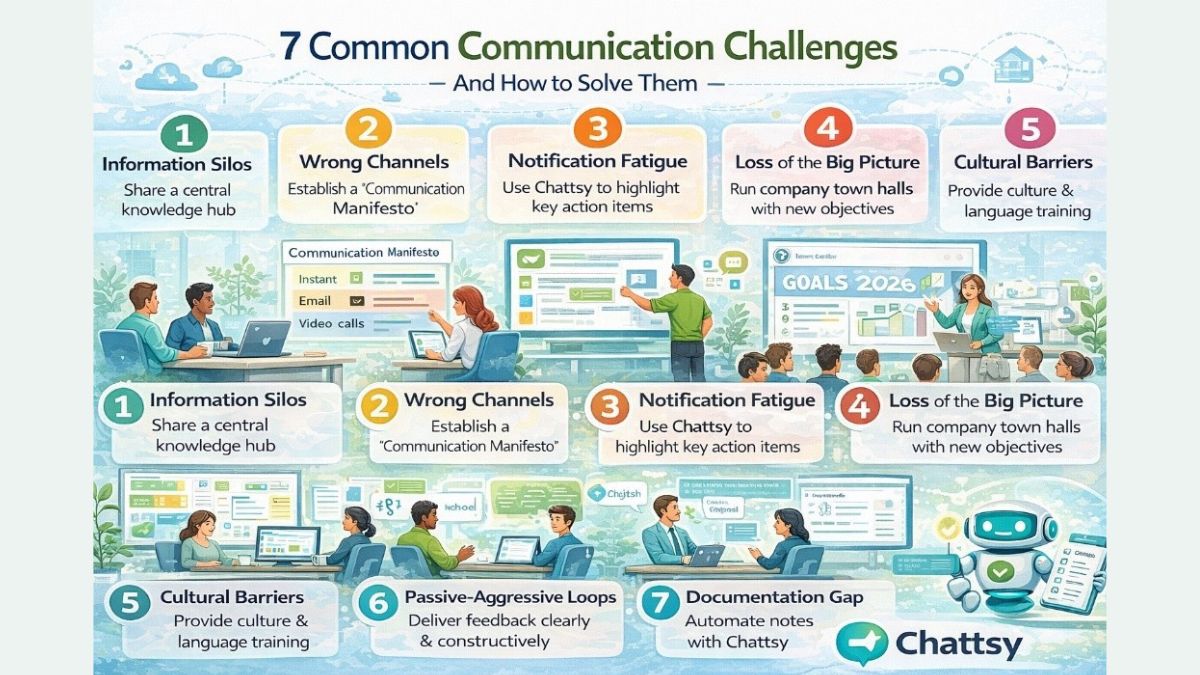
1. The Information Silo Effect: One of the Common Communication Challenges
Growing departments like Marketing, Sales, Engineering, and HR often develop unique ‘languages’ and patterns of information storage that create separate ‘silos’ of information. In many cases, the Sales team understands what the customer wants, but the Product team does not receive that information. Therefore, when the Product team develops new functionality, some of the new functionalities may not be of interest to customers.
The answer is to create areas for departments to connect and engage with one another (collisions). Creating opportunities for departments to collide does not necessarily mean having more meetings; rather, it means creating integrated platforms to allow everyone to see all collected data. The use of a single Source of Truth for the entire organization will ensure that when one team has information, the entire organization will also learn that information.
2. Choosing Wrong Channels and Other Common Communication Challenges
Everyone knows that there have been instances where an easy question turns into a 45-minute live video meeting when all that could have been asked is something in three sentences. Likewise, serious strategic questions sometimes become buried among instant messages with lots of emojis and replies that may not be formal enough.
The Solution: Draft a Communication Manifesto: A proper framework will provide clarity on the type of channels that should be used to promote efficiency and prevent miscommunication.
Channel Recommendations
- Instant Messaging Platform: Good for quick questioning and fast updates within the team.
- Email: For professional communication outside of the team and where there is a need for a permanent record.
- Video Calls: Where questions and issues are too complicated to be sorted out with just the words.
Publish your manifest on important platforms and check it up every quarter
3. Information Overload: Navigating Common Communication Challenges
As a growing business generates more communication (‘noise’), it can get challenging to sift through many emails to find critical items after returning to your desk from lunch only to find you have ~40 unread emails to process across five different applications. This skimming action will likely result in your missing some of the higher-priority tasks that need to be completed.
The Solution: Use tools that provide ‘Contextual Filtering’ and will allow you to see only what options are available, so you don’t have to read line by line. AI-driven platforms such as Chattsy are revolutionizing how we conduct business daily by highlighting only the items in a thread/conversation that you need to take action on or respond to. This helps clear out the clutter/noise. It allows you to focus more on the work that requires deep thinking.
4. The Loss of “The Big Picture” as Common Communication Challenges Grow
In the beginning stages of an organization, all of the staff can clearly relate to the company’s mission because they are living it, and therefore know what it is. However, as the organization continues to grow in size, newer employees may start to feel like they are just a “cog in the wheel” because they are only performing the tasks assigned to them with little understanding as to how their role fits into achieving the company’s annual objectives.
The Solution: Take every task and provide a “Why” to it. Any time you assign a project to someone, you should always remind them of how the assignment relates to the goals of your company. A monthly “Town Hall” meeting (virtually if necessary) should be conducted to explain the mission of the organization and appreciate the efforts made by the employees towards achieving the milestone.
5. Communication Barriers Based on Culture and Language: Ways to Tackle the Most Common Barriers in Communication
Organizational diversity is an asset, but it can at times create barriers to communication owing to differences in cultures and languages. For example, what might be considered “direct” communication in one culture will be seen as “aggressive” communication in another culture.
To resolve these issues, businesses should invest in “Global Fluency.” There are many communication issues in business that cause problems with day-to-day operation as well as the company’s overall performance. You may be experiencing this same type of problem in your group where you are trying to communicate something to a certain person but they either do not get it or are unable to get the information to the correct person.
6. Passive aggressive feedback: Overcoming common communication blocks
In a fast-paced environment, with teams feeling pressure from external forces, the provision of constructive feedback can become passive-aggressive. Phrases such as “per my last email” breed defensiveness and fear, making mistakes more of a punishment than a valuable learning experience for career growth.
7. The Documentation Gap: Communication Challenges In Fast Moving Teams
Fast paced growing companies will tend to make decisions quickly. They occur in the hallway, over a Slack DM, or directly after the Friday happy hour. If these decisions are not documented, they may as well not have occurred.
The Answer: Use A.I. Technology to Create “Operational Documentation” Automatically. The most powerful feature of Chattsy is its ability to serve as a silent scribe for recording conversations The system has the capability to record a conference call (or any type of conferencing) and provide a summary of the major decisions resulting from that call as well as create a list of “Next Steps” to help each party perform their respective follow-up actions. This will help every party remember their individual intention(s) as they relate to their telephone call, regardless of how long ago it was.
How It is Redefining the Solution to Business Communication Problems
- The scaling teams face an overload of chats, delays in projects, and lack of responsibility. In order to cope with these issues, many tools apply the capabilities of artificial intelligence technologies for transforming communication into tangible action.
- Generic Scaling Tools for Various Platforms Slack, Microsoft Teams, and Zoom, which are some popular applications, implement the capability of AI for automating processes other than chat functionality.
- Contextual AI Monitoring: This technology monitors entire conversation streams and identifies delays in the process, for example, the lack of any updates within 48 hours. It then alerts the concerned project owner about it.
- Thread Classification via AI: AI classifies thread posts under categories such as “Action Items” (owner and due date), “Updates”, saving up to 70% of manual effort in sorting.
- Automated Summary Creation: Request the summary by saying “Provide summary of channel X in Project Y in the last 3 hours” and get bullet-pointed information on decisions made, open issues, and next steps.
- Effectively Utilized Leading Tools: Artificial intelligence communication software tools have demonstrated their effectiveness in team expansion through tasks such as summarization, automation, and organizing, giving an efficiency rate of around 50-70%.
- Slack: The Slack AI enables you to summarize your channels, make important threads prioritized and also automate the workflow. The integration of Jira and Asana makes conversations turn into actions.
- Microsoft Teams: Microsoft Teams is integrated with Copilot AI that assists in insight generation, meeting summarization, and generation of action items.
- Zoom AI Companion: The Zoom application provides real-time summaries, important decision points, and tasks allocation after the completion of meetings.
- Specialized Option: Chattsy: In case you need a solution that helps your company grow, Chattsy will be a good choice because of its Contextual AI.
Conclusion
It’s hard to grow your business when your communication system is failing. By identifying these 7 common communication problems before you experience them, you’ve already made strides toward building an agile, open and prepared operation for the future. Whether you want to enhance your feedback loops, or use a technologically advanced tool such as Chattsy, each of these solutions has one goal – clarity.
(FAQs)
- How can you say that your team’s communication has hit rock bottom?
A clear indicator of ineffective communication is when you see “Duplicate Work.” If individuals are completing identical tasks because they each did not know that another individual was also working on that task. Alternatively, if someone does not complete a project in a timely fashion because he/she “did not receive the memo.” Then, it would indicate that there is a breakdown in structurally sound communications.
- Will an AI, like Chattsy, replace a human project manager?
An AI will not replace your project manager and should never take the place of someone. Instead, AI is designed to reduce the administrative burden associated with completing work; incorporating filing, summarizing and/or scheduling activities. The result of using AI is that business managers can now focus on doing what they do best; mentorship, strategic thinking and building relationships with their employees.
- How do we get our older employees to use new communication tools?
The key for older workers and younger workers who wish to adopt a new communication tool is “Value, not Features.” Do not focus on what features (i.e. AI or NLP) the new communication tool has; instead, focus on what benefits the new tool offers (i.e. Saving you 30 minutes typing every day). Once employees understand the benefits of a new tool, they are likely to use them.
- How frequently should we conduct an audit of our communication protocols?
A rapidly growing business should conduct communications audit every 6 months. Each time you add another layer of management or a new department will require you to re-audit the communication systems; as the previous systems will quickly become bottlenecks if modified to support the ever-expanding business entity.