




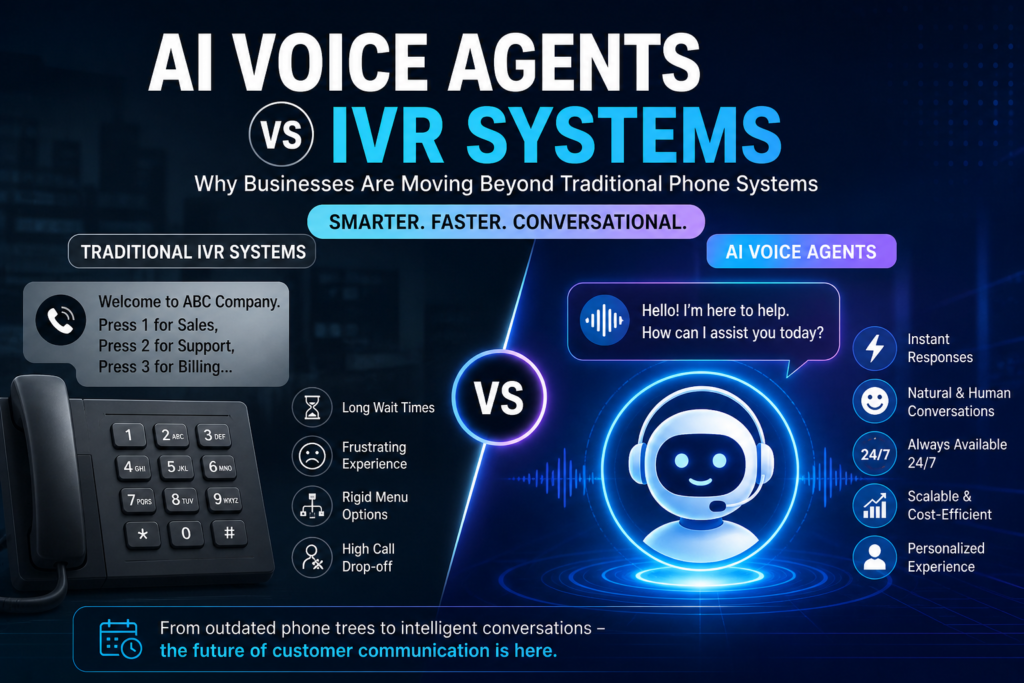
And what this shift means for businesses that still rely on phone trees.
If you’ve ever called a business and been greeted by “Press 1 for billing, press 2 for support,” you’ve experienced an IVR system. Interactive Voice Response has been the standard way businesses handle phone calls since the 1990s. It worked — to an extent.
But that era is gradually shifting. AI voice agents — systems capable of holding natural, human-like conversations over the phone — are increasingly replacing rigid phone trees. This shift is driven by advancements in speech synthesis, real-time language models, and modern telephony infrastructure.
Here’s why this transition is accelerating, what differentiates AI voice agents from IVR systems, and what businesses should consider before making the switch.
The Fundamental Problem with IVR
IVR systems were designed around a key limitation: computers couldn’t understand natural language. As a result, callers had to navigate decision trees using keypad inputs or limited voice commands.
This led to several challenges:
Caller frustration. Many users find IVR systems inefficient, often spending significant time navigating menus before reaching assistance — if they don’t drop off entirely.
Rigid routing logic. IVR systems can only handle predefined scenarios. If a request doesn’t match available options, users often get stuck.
High maintenance requirements. Even small updates, like changing menu flows or business hours, require technical intervention.
Limited personalization. Every caller receives the same experience, regardless of history or context.
These limitations directly impact customer experience and, in many cases, business outcomes.
What AI Voice Agents Do Differently
AI voice agents operate fundamentally differently. Instead of guiding users through menus, they enable natural conversations.
Callers can simply state their needs, such as rescheduling an appointment or asking about a service. The system understands intent, processes the request, and responds conversationally in real time.
Key technologies enabling this include:
- Large language models (LLMs): For understanding and generating natural responses
- Neural text-to-speech (TTS): Producing realistic, human-like voice output
- Speech-to-text (STT): Converting spoken language into text accurately and quickly
- Telephony integration: Enabling real-time call handling at scale
Together, these technologies allow AI agents to handle routine interactions efficiently without relying on rigid flows.
The Economics Behind Adoption
Cost is a major factor driving adoption.
Traditional call handling involves ongoing staffing costs, while AI voice agents operate at a significantly lower cost per interaction. More importantly, they provide consistent availability.
AI agents can handle calls instantly, 24/7, without delays. For businesses that miss calls due to workload or after-hours limitations, this can directly impact revenue capture and customer satisfaction.
Where AI Voice Agents Excel (and Where They Don’t)
AI voice agents are highly effective for predictable, high-volume interactions:
- Appointment scheduling and rescheduling
- Lead qualification
- FAQ handling and information requests
- Follow-ups and reminders
- After-hours support
However, they are less suited for:
- Emotionally sensitive conversations
- Complex technical troubleshooting
- Highly regulated interactions requiring strict compliance
In practice, the most effective approach is often a hybrid model, where AI handles routine queries and escalates complex cases to human agents.
The Implementation Landscape
Businesses have several options when adopting AI voice agents:
- All-in-one platforms: Quick to deploy and require minimal technical setup
- Custom-built solutions: Offer flexibility but require development resources
- Hybrid systems: Combine AI automation with human support
Choosing the right approach depends on business size, technical capacity, and use case requirements.
All-in-one platforms bundle the LLM, TTS, STT, and telephony into a single service. These are typically the fastest to deploy — some platforms advertise setup times of under 15 minutes — and require no technical expertise. They handle all the infrastructure complexity, including provider integrations, fallback routing, and call recording. For a detailed look at how modern voice agent architectures work, the Autocalls documentation provides a thorough technical overview of real-time voice pipeline design.
What to Evaluate Before Switching
Before adopting AI voice agents, businesses should consider:
- Latency: Response time should feel natural
- Voice quality: Real-world performance matters more than demos
- Interruption handling: Ability to manage natural conversation flow
- Integration: Compatibility with existing tools like CRM or scheduling systems
- Escalation logic: Smooth transition to human agents when needed
- Compliance: Adherence to data and call regulations
- Cost structure: Transparent pricing aligned with usage
The Future of Voice Interaction
AI voice technology continues to evolve rapidly. Improvements in accuracy, context awareness, and conversational quality are making these systems increasingly reliable.
As adoption grows, AI voice agents are expected to become a standard component of modern customer communication strategies.
Final Thoughts
Traditional IVR systems served an important role, but they are no longer aligned with modern expectations. AI voice agents offer a more flexible, efficient, and user-friendly alternative.
For businesses focused on improving customer experience and operational efficiency, this transition is becoming increasingly relevant.
This article explores the broader shift from IVR systems to conversational AI in telephony, reflecting current trends as of 2026.


