




Key Takeaways
- 82.6% of phishing emails now utilize AI, making traditional security measures obsolete
- AI chatbots combine NLP, machine learning, and behavioral analytics to detect threats in real-time
- Organizations implementing AI security chatbots report 40-60% reduction in response times
- Critical risks include false positives, AI hallucinations, and prompt injection vulnerabilities
- Success requires RAG architecture, human oversight, and zero-trust implementation principles
In March 2025, cybersecurity researchers uncovered a startling statistic: 82.6% of all phishing emails now leverage artificial intelligence. This isn’t a future threat, it’s happening now. Traditional security systems are failing at an alarming rate.
As adversaries weaponize AI to generate sophisticated phishing campaigns and exploit vulnerabilities at machine speed, security teams face an urgent question: How do you fight AI-powered attacks? The answer increasingly lies in AI-powered defense.
AI chatbots in cybersecurity are being integrated into Security Operations Centers (SOCs) worldwide. Powered by natural language processing (NLP), machine learning, large language models (LLMs), and behavioral analytics, these systems function as autonomous security assistants. They’re capable of threat analysis and real-time response coordination, going far beyond simply answering user questions.
This article examines how AI chatbots in cybersecurity detect cyber threats, presents current threat data, explores real-world applications, and discusses both the potential and the risks of this emerging technology.
The Evolving Threat Landscape: AI-Powered Attacks Demand AI-Powered Defense
The Surge in AI-Generated Phishing
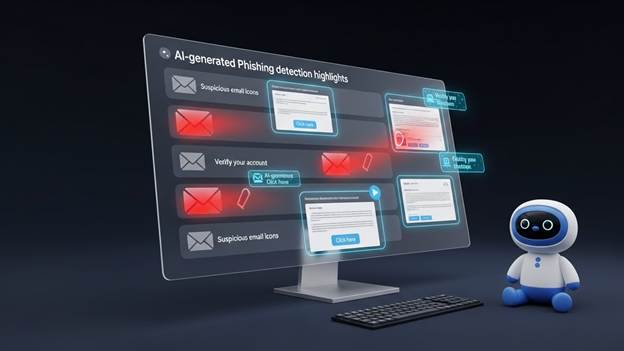
The explosive growth of AI-enhanced phishing attacks represents one of the most concerning developments in modern cybersecurity. According to KnowBe4’s Phishing Threat Trends Report released in March 2025, 82.6% of all phishing emails analyzed between September 2024 and February 2025 utilized some form of artificial intelligence.
Security Magazine further reported that polymorphic phishing attacks which subtly alter each email to evade detection have become commonplace. Most campaigns now leverage AI capabilities to bypass traditional defenses.
This dramatic shift in attack sophistication renders many traditional email filtering systems significantly less effective. AI-generated phishing attempts increasingly resemble legitimate business communication, making detection more challenging than ever.
Breach Patterns and the AI Factor
The 2024/2025 Verizon Data Breach Investigations Report (DBIR) indicated that vulnerability exploitation and system intrusions remain primary breach vectors. However, security researchers increasingly argue that the asymmetric nature of cyber conflict where attackers innovate rapidly necessitates equally advanced defensive technologies.
Understanding the scale of AI-enhanced threats makes the need for equally sophisticated defenses clear. Here’s how AI chatbots in cybersecurity are rising to meet this challenge:
How AI Chatbots Detect and Respond to Cyber Threats
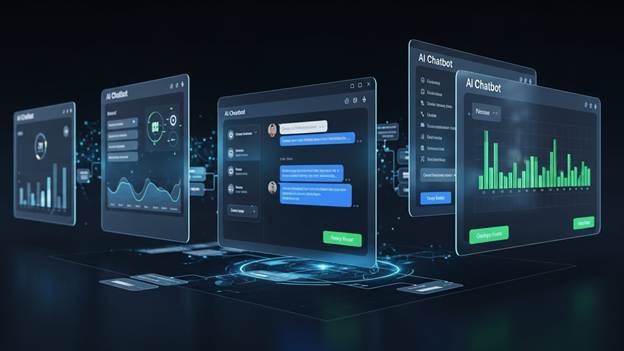
AI chatbots in cybersecurity bring together multiple advanced technologies to identify risks and coordinate automated responses:
Natural Language Processing and Intent Analysis
Modern security chatbots analyze communication patterns beyond simple keyword matching. They assess linguistic intent, identifying suspicious phrasing or unusual requests. For example, urgent financial transfers from infrequently contacted colleagues may indicate compromise or social engineering attempts.
Behavioral Modeling and Anomaly Detection
Using supervised machine learning algorithms, these systems establish baselines for normal organizational behavior. This includes typical login patterns, data access sequences, and network traffic volumes. Significant deviations trigger automated alerts for security team review.
LLM-Powered Risk Interpretation
Large Language Models enable chatbots to translate complex security logs into actionable insights. Rather than presenting raw data, they summarize unusual activity patterns and assess potential risk levels. They also recommend specific response actions in plain language that security personnel can quickly understand and act upon.
Retrieval-Augmented Generation for Accuracy
To minimize the risk of AI hallucinations or incorrect guidance, enterprise-grade security chatbots employ Retrieval-Augmented Generation (RAG). This approach retrieves information from verified sources CVE databases, internal security policies, and incident response playbooks before formulating recommendations. This significantly improves accuracy and reliability.
Automated Threat Response Coordination
Based on assessed risk levels, AI chatbots in cybersecurity can initiate immediate protective measures. These include account lockdowns, multi-factor authentication enforcement, email quarantine, endpoint isolation, and escalation to human analysts. This automation substantially reduces response times during critical incidents.
Real-World Applications Across Industries
Phishing Defense and Email Security
Organizations deploying AI chatbots in cybersecurity for email security report improved detection of sophisticated phishing attempts. These systems analyze sender behavior, linguistic patterns, and embedded links to flag suspicious messages. They often provide real-time warnings to users with contextual explanations of identified risks.
Incident Response Automation
When security alerts trigger, chatbots serve as first-tier responders. They perform initial triage, retrieve relevant log data, and conduct preliminary risk assessments. They then escalate appropriately to human analysts.
Organizations implementing chatbot development services for security operations should prioritize integration with existing SIEM and incident response platforms. This approach reduces mean time to detection (MTTD) and mean time to resolution (MTTR) for many common security events.
Identity and Access Management
Integration with IAM systems allows AI chatbots in cybersecurity to verify login attempts using behavioral signals. They enforce adaptive authentication requirements and manage account access based on risk scores. This creates an additional layer of defense against credential compromise and account takeover attempts.
Vulnerability Intelligence
Security chatbots continuously monitor vulnerability databases and threat intelligence feeds. They alert teams to newly disclosed vulnerabilities affecting their environment. Using RAG, they can provide organization-specific remediation guidance rather than generic patching instructions.
Security Awareness Training
Beyond static training modules, AI chatbots in cybersecurity deliver contextual security education. They conduct simulated phishing exercises and provide real-time intervention when users exhibit risky behaviors. This helps build a stronger security culture through immediate feedback.
These practical applications translate into measurable advantages that are reshaping security operations:
Benefits and Strategic Advantages
Leading organizations implementing AI chatbots in cybersecurity report measurable improvements:
Continuous Operation: AI systems analyze security events around the clock without fatigue. They provide consistent monitoring coverage across all time zones.
Pattern Recognition: Advanced analytics identify subtle anomalies that rule-based systems frequently miss. According to IBM’s Security Intelligence Report, AI-powered systems detect threats 60% faster than traditional SIEM tools.
Operational Efficiency: Automation of routine triage and response tasks allows human analysts to focus on complex investigations. Organizations report reducing tier-1 analyst workload by 40-50%. This frees expertise for strategic security initiatives.
Scalability: Chatbots handle high volumes of concurrent alerts and user interactions that would overwhelm traditional SOC staffing models. A single AI system can process 10,000+ security events per second.
Reduced Human Error: Real-time guidance helps users recognize and avoid threats, particularly sophisticated social engineering attempts. Security awareness programs enhanced with AI chatbots show a 35% reduction in successful phishing attempts.
While these advantages are compelling, responsible implementation requires acknowledging and managing significant challenges:
Significant Risks and Implementation Challenges
Despite their potential, AI chatbots in cybersecurity introduce notable risks that organizations must carefully manage:
False Positive Rates: Improperly tuned systems generate alert fatigue. This potentially causes analysts to overlook genuine threats buried in noise.
AI Hallucinations: Without robust RAG implementation and validation mechanisms, chatbots may provide incorrect or even dangerous security guidance. Understanding the risks and disadvantages of chatbots is essential before deployment.
Prompt Injection Vulnerabilities: Sophisticated attackers could potentially manipulate chatbot behavior through carefully crafted inputs. This could cause systems to bypass security controls.
Excessive Permissions: Over-privileged chatbots represent attractive targets. If compromised, they could be weaponized against the organization they’re meant to protect.
Compliance and Privacy Concerns: Chatbots processing sensitive data must align with regulatory frameworks. These include GDPR, HIPAA, and industry-specific requirements.
Security teams should apply zero-trust architecture principles to chatbot deployments. They must enforce strict API access controls, maintain comprehensive audit logging, and require human approval for high-impact security decisions.
Implementation Best Practices for Security Teams
Organizations considering AI chatbots in cybersecurity deployment should follow these evidence-based approaches:
Begin with Defined Use Cases
Start with specific, measurable applications such as phishing detection or alert triage. Choose areas where ROI can be clearly demonstrated.
Deep Integration
Connect chatbots with existing security infrastructure. This includes SIEM platforms, EDR systems, IAM tools, and ticketing workflows.
Train on Organizational Data
Generic models should be fine-tuned using your actual security logs, threat intelligence, and internal policies. This ensures maximum relevance to your specific environment.
Implement RAG Architecture
Always retrieve information from verified, authoritative sources before making risk assessments or recommendations. This minimizes hallucinations and improves decision quality.
Maintain Human Oversight
Require human approval for high-risk actions. These include account termination or system isolation. AI should augment, not replace, human judgment in critical decisions.
Robust Governance
Log all chatbot actions and audit access patterns. Restrict permissions according to least-privilege principles. Establish clear accountability frameworks for AI-driven security decisions.
Conclusion
The cybersecurity landscape has reached an inflection point. With more than 80% of phishing emails now incorporating AI according to recent threat intelligence, defensive strategies must evolve accordingly. AI chatbots in cybersecurity offer security teams powerful capabilities for threat detection, incident response, and operational efficiency at scale.
Yet these tools require careful implementation. Organizations must balance automation benefits against risks including false positives, AI vulnerabilities, and compliance requirements. Success depends on thoughtful architecture, robust governance, continuous refinement, and maintaining human expertise in the security decision-making process.
Organizations that develop mature AI security capabilities with appropriate safeguards and realistic expectations will be better positioned to defend against increasingly sophisticated threats. Those that rush deployment without adequate risk management may find these tools create as many problems as they solve.
Next Steps for Security Leaders
Organizations ready to explore AI chatbots in cybersecurity implementation should:
- Assess Current State: Audit existing security infrastructure and identify integration points
- Define Success Metrics: Establish baseline MTTD and MTTR measurements before deployment
- Start Small: Pilot with low-risk use cases like phishing detection or alert triage
- Build Expertise: Train security teams on AI system oversight and prompt engineering
- Plan for Governance: Develop policies for AI decision-making authority and audit trails
The transformation has already begun. The question isn’t whether AI will reshape cybersecurity it’s whether your organization will lead or follow.
References
KnowBe4. “Phishing Threat Trends Report.” March 2025. Available at: knowbe4.com
Security Today. “Report: 82 Percent of Phishing Emails Used AI.” April 15, 2025.
Verizon. “2024 Data Breach Investigations Report: Executive Summary.” Available at: verizon.com
Security Magazine. “Polymorphic Phishing Attacks.” securitymagazine.com


