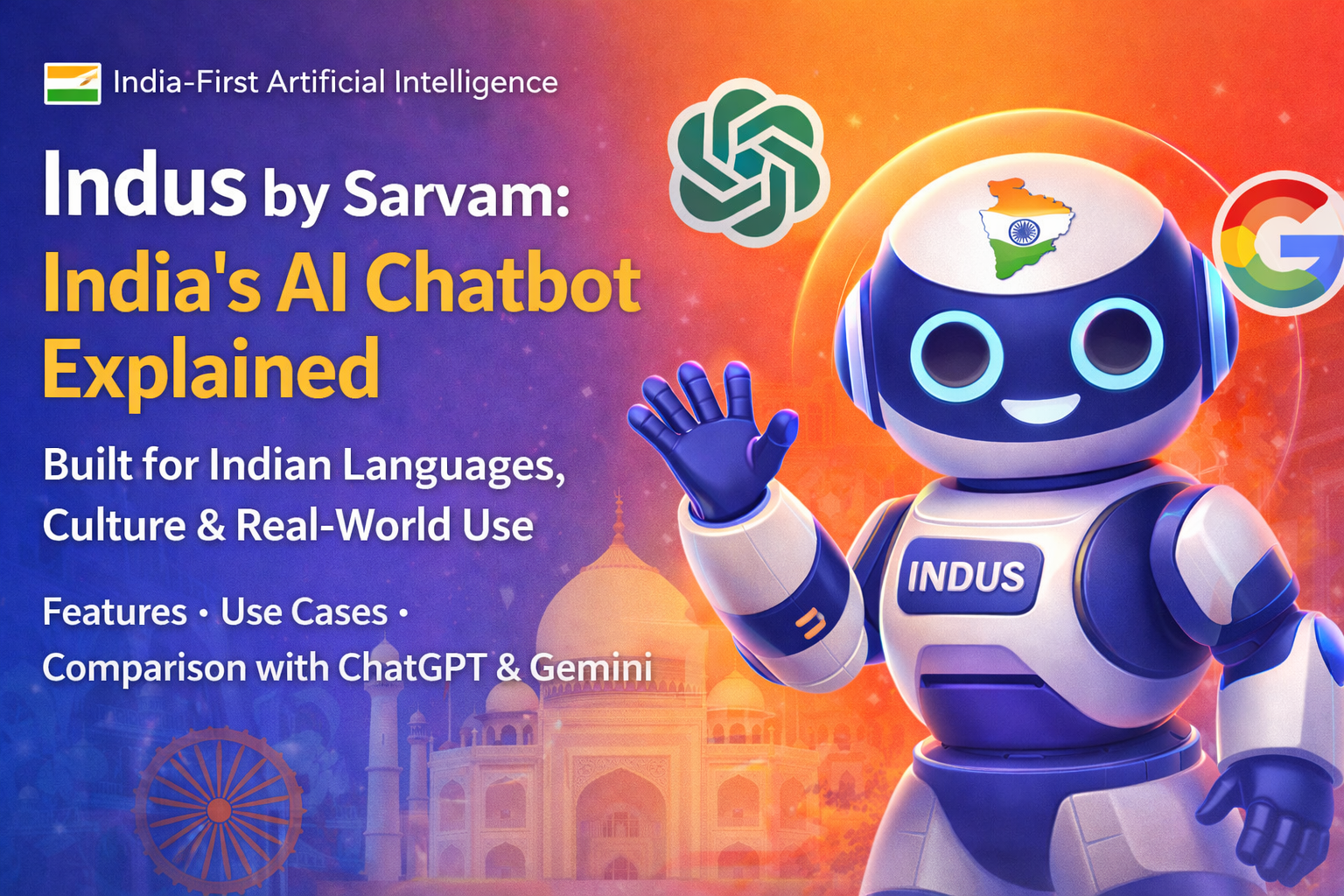
Indus by Sarvam: India’s AI Chatbot Explained – Features, Use Cases & How It Compares with ChatGPT and Gemini

Artificial Intelligence is no longer a distant concept for India. From students using AI to draft assignments to startups automating customer support, AI tools are slowly becoming part of everyday workflows. In this fast-moving space, a new name has started gaining attention: Indus by Sarvam.
Positioned as India’s own AI chatbot, Indus is being discussed as a homegrown alternative to global giants like ChatGPT and Google Gemini. But what exactly is Indus? Why does it matter so much for the Indian ecosystem? And can it really compete with established global AI models?
Let’s break it down in a simple, practical, and honest way.
What Is Indus by Sarvam?
Indus is an AI-powered conversational chatbot developed by Sarvam AI, an Indian artificial intelligence company focused on building language models and AI systems tailored specifically for India.
Unlike global AI chatbots that are trained primarily on Western datasets and English-first content, Indus is designed with India at its core. That means:
- Better understanding of Indian context
- Strong focus on Indian languages
- Sensitivity to local culture, expressions, and use cases
In short, Indus aims to make AI more accessible and useful for India’s diverse population.
Why India Needed Its Own AI Chatbot
To understand why Indus matters, we need to look at India’s reality.
India is not a single-language, single-context country. It is:
- Home to 22 official languages
- Used by millions who are more comfortable in Hindi, Tamil, Telugu, Bengali, Marathi, and other regional languages
- Driven by small businesses, students, creators, and professionals who often feel left out by English-heavy tech platforms
Most global AI tools work well in English but struggle with:
- Code-mixed languages (like Hinglish)
- Regional phrasing and cultural nuance
- Local knowledge and real-life Indian scenarios
Indus is being built to fill this gap.
Key Features of Indus AI Chatbot
1. Strong Focus on Indian Languages
One of the biggest highlights of Indus is its support for Indian languages. The chatbot is designed to understand and respond naturally in multiple regional languages, making it far more approachable for non-English users.
This is a huge step toward AI inclusion in India.
2. India-Centric Context Understanding
Indus performs better when queries involve:
- Indian education system
- Government-related topics (general guidance)
- Local business scenarios
- Indian cultural references
This makes it more practical for daily Indian use compared to global chatbots that sometimes give generic or irrelevant answers.
3. Conversational and Simple Responses
Indus is designed to sound conversational and easy to understand. Instead of over-complicated explanations, it focuses on clarity—something especially useful for beginners and students.
4. Built for Scale in India
Sarvam AI is building Indus keeping India’s scale in mind. From students and educators to small business owners and creators, the tool is meant to handle diverse, high-volume usage.
Real-World Use Cases of Indus AI
For Students
- Explaining concepts in regional languages
- Helping with notes and summaries
- Clarifying doubts in a simple tone
For Small Businesses
- Drafting basic content in local languages
- Customer support responses
- Understanding business concepts without technical jargon
For Content Creators
- Generating ideas rooted in Indian trends
- Writing scripts, captions, or outlines
- Translating content across Indian languages
For Everyday Users
- Asking general questions
- Learning new topics without language barriers
- Getting help in a more familiar conversational style
Indus vs ChatGPT: What’s the Difference?
Language Strength
- Indus: Strong in Indian languages and mixed-language queries
- ChatGPT: Excellent English performance, improving but limited regional depth
Cultural Context
- Indus: Built with Indian context from the ground up
- ChatGPT: Global perspective, sometimes misses local nuance
Use Case Focus
- Indus: Students, local businesses, Indian creators
- ChatGPT: Developers, professionals, global users
Advanced Capabilities
- Indus: Still evolving
- ChatGPT: Strong in coding, reasoning, and advanced workflows
Indus vs Google Gemini
Google Gemini benefits from deep integration with Google’s ecosystem, search data, and productivity tools. However:
- Gemini is still largely English-first
- Regional language performance varies
- Indian cultural understanding is improving but not native
Indus, on the other hand, feels more locally aware even if it currently lacks Gemini’s scale and integrations.
Is Indus Better Than Global AI Tools?
The honest answer: It depends on what you need.
If your priority is:
- Indian languages
- Local context
- Simple explanations
Indus can feel more natural.
If your priority is:
- Advanced coding
- Complex reasoning
- Global research
ChatGPT or Gemini may still be better options.
Indus is not trying to replace global AI—it’s trying to serve India better.
Why Indus Matters for India’s AI Future
Indus represents something bigger than just another chatbot.
It shows:
- India building its own AI infrastructure
- Reduced dependency on foreign AI models
- More control over data, language, and cultural representation
For a country as large and diverse as India, this is a crucial step forward.
Challenges Indus Still Faces
No AI tool is perfect, especially in its early stages.
Some challenges include:
- Competing with well-funded global AI companies
- Expanding accuracy across all Indian languages
- Scaling performance while maintaining quality
However, these are expected hurdles—and ones that can be improved over time.
Indus AI Architecture: How It’s Being Built for India
Behind Indus is a clear technical philosophy: build language intelligence that reflects how Indians actually speak, write, and think.
Sarvam AI is reportedly focusing on:
- Training models on Indian-language datasets
- Handling code-mixed language (Hinglish, Tanglish, etc.)
- Improving semantic understanding for Indian names, places, and contexts
This matters because most global AI models struggle when users mix languages or use informal Indian expressions. Indus is designed to treat this as a feature, not a problem.
How Indus Handles Indian Languages Differently
Indian languages are complex. Grammar, sentence structure, and regional variation change dramatically from state to state. Indus attempts to handle this by:
- Understanding intent even when grammar is imperfect
- Responding in simpler, more conversational language
- Supporting transliteration (typing Hindi in English letters, for example)
For many users, this removes the fear of “typing correctly” and makes AI feel more human and approachable.
Indus for Education: A Big Opportunity
India has one of the world’s largest student populations. However, access to quality education remains uneven.
Indus could play a meaningful role by:
- Explaining concepts in regional languages
- Acting as a personal tutor for basic subjects
- Helping students revise, summarize, and understand topics
Unlike global tools that often assume a certain level of English proficiency, Indus meets learners where they are.
Indus for Small Businesses and Local Entrepreneurs
India runs on small businesses. From shop owners to local service providers, millions operate with limited access to digital tools.
Indus can help by:
- Drafting WhatsApp replies for customers
- Creating simple marketing content in local languages
- Explaining basic business, GST, or digital concepts
This is where an India-first AI tool can have real economic impact.
Data Privacy and Local AI Development
One of the most important conversations around AI today is data privacy.
A domestically developed AI tool like Indus raises important possibilities:
- Better alignment with Indian data regulations
- Reduced reliance on foreign AI infrastructure
- Greater transparency for Indian users
While long-term policies will shape this further, the direction itself is significant.
Indus vs ChatGPT vs Gemini: A Deeper Comparison
Language and Accessibility
- Indus: Optimized for Indian languages and mixed-language queries
- ChatGPT: Strong English, improving multilingual support
- Gemini: Good multilingual capabilities but still global-first
Use Case Alignment
- Indus: Education, small businesses, everyday users
- ChatGPT: Developers, professionals, researchers
- Gemini: Google ecosystem users
Ease of Use
- Indus: Simple, conversational, beginner-friendly
- ChatGPT: Powerful but sometimes overwhelming
- Gemini: Useful but tied closely to Google products
Limitations to Keep in Mind
Indus is still evolving. Users may notice:
- Limited advanced reasoning compared to global models
- Fewer integrations with third-party tools
- Inconsistent depth across all regional languages
These are not deal-breakers, but realistic expectations help.
The Bigger Picture: Why Indus Is More Than a Chatbot
Indus represents a mindset shift.
It shows that:
- India is ready to build foundational AI
- Language inclusion is becoming a priority
- AI doesn’t have to be one-size-fits-all
This approach could inspire more region-specific AI development globally.
What the Future Could Look Like for Indus
If Indus continues to evolve, future possibilities include:
- Deeper regional language accuracy
- Voice-based AI for non-text users
- Integration with Indian education and government platforms
- Custom tools for creators and entrepreneurs
Its success will depend on adoption, feedback, and continuous improvement.
Final Thoughts: Is Indus Worth Paying Attention To?
Indus by Sarvam may not yet be the most powerful AI chatbot in the world, but it is one of the most meaningful for India.
By focusing on language inclusion, local context, and accessibility, it addresses gaps that global AI tools often overlook.
For students, small businesses, creators, and everyday users in India, Indus feels less like a foreign technology and more like a familiar assistant.
As India’s AI ecosystem matures, tools like Indus will likely play a crucial role—not just in how we use AI, but in how we shape it.
Indus is not trying to compete with the world. It is trying to serve India. And that may be exactly what makes it powerful.
Frequently Asked Questions (FAQs)
❓ What is Indus by Sarvam?
Indus by Sarvam is an AI-powered chatbot developed by Sarvam AI, designed specifically for Indian users. It focuses on Indian languages, local context, and real-world use cases, making AI more accessible across India.
❓ Is Indus really India’s alternative to ChatGPT?
Indus is often described as India’s alternative to ChatGPT because it is built with an India-first approach. While ChatGPT is more advanced in global use cases, Indus performs better for Indian languages, mixed-language queries, and local context.
❓ Which Indian languages does Indus AI support?
Indus is designed to support multiple Indian languages and code-mixed formats like Hinglish. Its language capabilities are continuously expanding as Sarvam AI improves the model.
❓ How is Indus different from ChatGPT and Google Gemini?
Indus focuses on Indian culture, languages, and everyday use cases. ChatGPT excels in advanced reasoning and coding, while Google Gemini integrates deeply with Google’s ecosystem. Indus stands out for its local relevance and accessibility.
❓ Can students use Indus AI for learning?
Yes. Students can use Indus to understand concepts in regional languages, create summaries, revise topics, and get simple explanations, making learning more inclusive and less intimidating.
❓ Is Indus useful for small businesses?
Absolutely. Small business owners can use Indus to draft customer messages, create basic marketing content, and understand business concepts in local languages without technical complexity.
❓ Is Indus AI free to use?
Availability and pricing may vary based on future updates. Currently, Indus is positioned as an accessible AI tool, and Sarvam AI may introduce different usage models as the platform evolves.
❓ Does Indus AI understand Hinglish and mixed-language queries?
Yes. One of Indus’s strengths is handling mixed-language communication such as Hinglish, which many global AI chatbots still struggle with.
❓ Is Indus AI safe in terms of data privacy?
As an India-developed AI platform, Indus opens up possibilities for better alignment with Indian data regulations. However, users should always review official privacy policies for the latest information.
❓ Who should try Indus AI?
Indus is ideal for students, educators, creators, small businesses, and everyday users in India who want an AI assistant that understands local languages and context.
❓ Will Indus replace global AI tools in the future?
Indus is not designed to replace global AI tools like ChatGPT or Gemini. Instead, it aims to complement them by serving Indian users more effectively with local relevance and accessibility.