From Confusion to Clarity: A Grandmother Learns Digital Literacy Amid AI, Cybersecurity, and Fake News
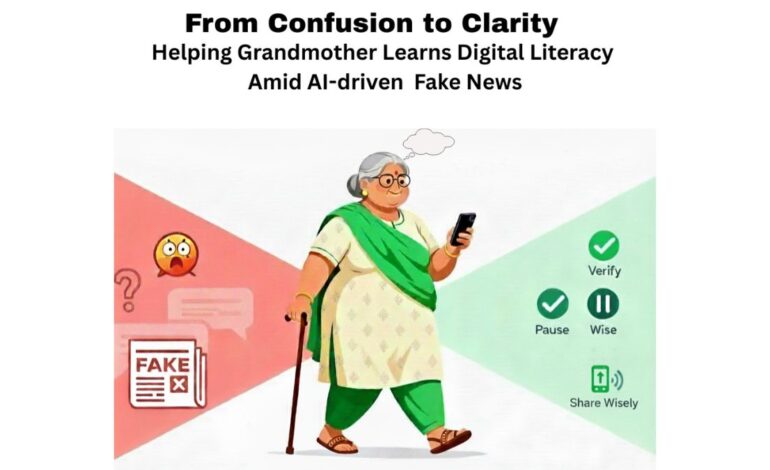

This blog tells the true story of how our grandmother got completely thrown off by viral misinformation—and how we turned that moment into a fun, hands-on crash course in digital literacy. From shock to confidence, she learned what AI can do, why fake news spreads so easily, and how to fact-check like a pro.
Step by step, she learned how AI can create realistic but misleading content, how to verify facts, and why digital literacy is essential. Along the way, we share simple, practical tips anyone can use to spot fake content and stay smart online. It’s a lighthearted yet eye-opening journey into why digital literacy matters today.
How This Story Started
The motivation behind this blog came from a very real incident at home. One morning, our grandmother saw a video online claiming that a famous personality had passed away. The video was edited so realistically—with dramatic music, emotional narration, and convincing visuals—that she believed it instantly.
When we told her it was fake, she was shocked.
“How can something fake look so real?” she asked.
That question sparked an idea.
We decided to create a simple AI demo to show her how these things work. Through this experience, we realized just how easy it is for seniors to fall for misinformation—and how crucial digital literacy has become for every generation.
Using narrative-based examples, we explained how AI can learn a person’s face and voice to create convincing fake videos. We also explored AI chatbots and discussed how misinformation spreads so quickly online. This step-by-step learning experience highlighted the importance of digital literacy across generations.
Using a real family story, this blog explains how simple tools and clear guidance can help protect vulnerable groups from misinformation—especially seniors who rely heavily on smartphones, WhatsApp, and YouTube for news and updates.
To help her understand more clearly, we used an AI app to create a video using her photo—showing her saying things she never actually said. This simple demonstration made it instantly clear how easily AI can manipulate images and videos.
What This Blog Covers
This blog tackles one of today’s biggest challenges: the rise of AI-generated fake news and its impact on people of all ages—especially seniors.
Here’s what we explore:
- Why spotting AI deepfakes is so difficult
- How simple, at-home steps can build digital awareness
- The growing trend of misinformation on social platforms
- Why digital literacy matters to prevent confusion, panic, and emotional harm
Through a real family story, we share practical, easy-to-follow strategies that help non-technical users recognize fake content and pause before hitting “forward.”
Understanding AI and Misinformation
This blog also serves as a practical guide for anyone curious about AI and misinformation. Using our grandmother’s story as a starting point, we break down complex AI concepts into simple, relatable explanations.
Readers learn about deepfake videos, AI chatbots, and AI-generated content—and, more importantly, how to identify when something isn’t real. We share step-by-step methods for recognizing AI-generated content and verifying authenticity using easy-to-follow tools. Think of it as a hands-on tutorial for building digital confidence, regardless of technical background.
Learning Through Humor and Real Moments
Humor played a big role in helping her learn.
When we explained deepfakes, she joked,
“So AI can make me dance like a movie star? Please make one—I’ll show it to the neighbors!”
After learning about fake news, she laughed and said,
“Next time someone sends me a rumor, I’ll reply with a recipe instead. That’s more useful!”
When shown an AI-generated image, she added,
“If AI can make me look younger, tell it to also do my laundry!”
While practicing fact-checking, she quipped,
“If only AI could check who ate the last piece of cake at home!”
We laughed—but the learning was real and lasting.
Building Her Digital Habits
We introduced her to one simple rule: Pause, Check, Then Share.
She now follows five easy steps:
- Double-check before believing any news
- Check the date and the source
- Ignore dramatic background music
- Think before forwarding anything
- Ask a family member when unsure
Today, she proudly says:
“I check everything. No one can fool me. Technology is smart—but now I am smarter too!”
Why This Matters
Fake news is not just misleading—it can be emotionally disturbing. In many cases, misinformation causes unnecessary panic, stress, and emotional harm.
In a recent Indian example, fake news about a well-known actor’s death spread online before it was confirmed. The false information caused confusion, sadness, and distress among millions of people.
This highlights how important it is to verify information before believing or sharing it.
Real-World Example: How Fake News Spreads
A widely shared video falsely claimed that a well-known Indian actor, Dharmendra, had passed away. At the time, the news was completely false, yet it spread rapidly across social media, causing emotional distress for fans, families, and the public.
This example shows how misinformation can:
- Spread faster than the truth
- Disturb families and communities
- Affect public sentiment
- Harm mental health
Tools We Used to Demonstrate AI
To explain AI concepts in a simple way, we used an AI face-swapping tool:
- To generate a sample video using our grandmother’s photo
- To demonstrate how easily someone’s face can be placed into a video
- To explain the concept of deepfakes in a clear, non-technical way
Conclusion
This simple home experiment taught us several important lessons. AI can create extremely realistic fake content, and elderly users are often the most vulnerable to misinformation. Digital literacy is no longer optional—it’s essential for every family.
By showing real examples rather than giving long explanations, and by following a few simple rules, families can protect themselves from false information. Helping even one family member understand AI better strengthens digital safety for the entire household.