AI Tools Every Content Creator Should Be Using in 2026 (And How They’re Quietly Changing the Way We Create)
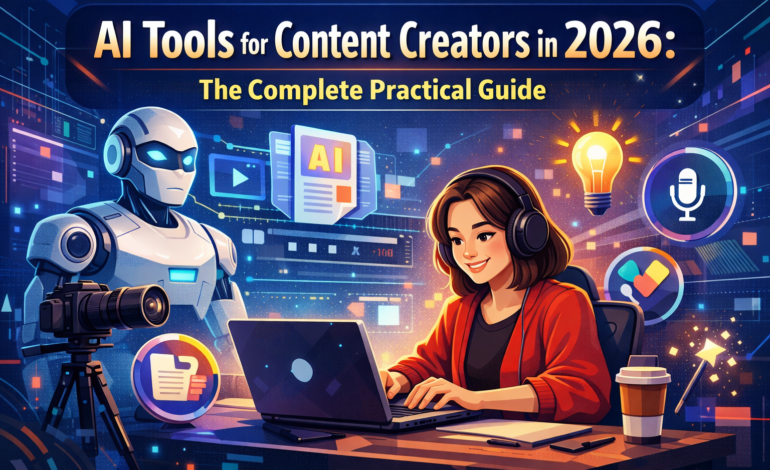

In 2026, content creation no longer looks like a glamorous process of inspiration, coffee, and creativity flowing endlessly.
It looks more like this:
A creator wakes up with three ideas, ten deadlines, multiple platforms to publish on, and a constant pressure to stay relevant — while algorithms keep changing and attention spans keep shrinking.
The biggest problem isn’t talent.
It’s capacity.
Creators today are not failing because they aren’t good enough. They’re overwhelmed because the system demands more output, more consistency, and more speed than any human can sustainably deliver alone.
This is exactly where AI has stepped in — not as a replacement for creators, but as a structural support system.
AI tools in 2026 are no longer “nice to have.” They are the backbone of modern creative workflows. The creators who understand this are building momentum. The ones who resist it are slowly burning out.
This article is not a list of tools.
It’s a deep dive into how AI tools actually fit into a creator’s life — practically, ethically, and creatively.
The Real Shift: From “Creating Content” to “Running a Content System”
Earlier, content creation was task-based:
- Write a blog
- Edit a video
- Design a post
In 2026, successful creators think in systems, not tasks.
They ask:
- How can one idea become ten pieces of content?
- How can effort compound instead of reset every day?
- How can I create without exhausting myself?
AI tools make this shift possible.
They help creators move from doing everything manually to designing workflows where creativity flows without friction.
AI Writing Tools: Not Replacing Writers, But Saving Them From Burnout
Let’s clear a myth first.
AI writing tools are not killing writing.
They’re killing blank pages, overthinking, and unnecessary struggle.
Writing has always been mentally expensive. The hardest part is not expressing ideas — it’s organizing thoughts, maintaining flow, and staying consistent day after day.
How creators actually use AI writing tools in 2026
Smart creators don’t say:
“Write my blog.”
They say:
- “Help me structure this idea.”
- “Give me 5 different hooks.”
- “Rewrite this paragraph more clearly.”
- “Turn this blog into a newsletter version.”
AI becomes a thinking assistant, not an author.
Writers remain in control of:
- Opinions
- Experience
- Voice
- Context
AI simply removes friction.
This is why creators who use AI often write more authentically — because they’re less exhausted by the mechanics.
AI and Video Creation: The Collapse of a 10-Step Process Into 2
Video used to be the most intimidating form of content.
You needed:
- Equipment
- Editing skills
- Time
- Confidence
In 2026, AI has collapsed video creation into a much smaller, more approachable process.
What AI does for video creators now
AI tools help creators:
- Turn scripts into short videos
- Automatically generate subtitles
- Remove awkward pauses
- Repurpose long videos into clips
- Maintain visual consistency
This has completely changed who can create video content.
Educators, writers, consultants, and founders — people who never thought of themselves as “video creators” — are now publishing confidently.
Not because they became editors.
But because AI removed the technical barriers.
AI Voice Tools: Giving Creators a Voice Without Recording One
Audio content has exploded — but not everyone wants to record their voice every day.
AI voice tools have quietly solved one of the most underrated creator problems: energy management.
Why creators rely on AI voice tools
Creators use AI voice tools when:
- They’re producing content at scale
- They need consistency across videos
- They want to avoid repeated recordings
- They’re creating multilingual content
Instead of spending hours recording and re-recording, creators:
- Focus on scripting
- Iterate faster
- Make quick edits without redoing everything
AI voice tools don’t replace human storytelling — they support execution.
AI Design Tools: When Visuals Stop Being a Bottleneck
Design used to be a major limitation for creators.
You either:
- Hired a designer
- Learned design tools
- Settled for mediocre visuals
AI changed that equation.
What AI design tools do differently
They don’t turn creators into designers.
They turn design into a conversation.
Creators now:
- Describe what they want
- Experiment freely
- Generate multiple variations
- Adjust visuals quickly
This has removed the fear of “not looking professional enough.”
Visual quality is no longer a gatekeeper.
AI for Research, Ideation, and Thinking Clearly
One of the least talked-about benefits of AI is mental clarity.
Before creating content, creators struggle with:
- Too many ideas
- Too much information
- No clear structure
AI helps creators think better, not just faster.
How creators use AI for thinking
AI is used to:
- Break complex topics into simple explanations
- Summarize research
- Explore opposing viewpoints
- Create logical content flow
This results in content that feels:
- More thoughtful
- Better structured
- Easier to consume
Good content starts with clear thinking — AI supports that clarity.
AI Automation: Protecting Creativity by Reducing Chaos
Creativity doesn’t die because of lack of ideas.
It dies because of overload.
Creators today manage:
- Posting schedules
- Repurposing
- Performance tracking
- Planning
AI automation tools act like invisible assistants.
What gets automated
Creators automate:
- Content scheduling
- Cross-platform repurposing
- Basic performance summaries
- Workflow organization
This frees up mental space — which is essential for creativity.
The Most Important Lesson: Fewer Tools, Better Systems
A common mistake creators make is collecting tools.
In 2026, successful creators do the opposite.
They:
- Choose a small AI stack
- Use it deeply
- Build habits around it
A powerful creator stack might include:
- One AI writing assistant
- One video or voice tool
- One design tool
- One automation system
That’s enough.
More tools don’t equal more productivity.
Better integration does.
What AI Still Cannot Do (And Why That’s a Good Thing)
AI cannot:
- Replace lived experience
- Understand cultural nuance fully
- Feel emotion
- Take moral responsibility
And that’s exactly why human creators still matter.
AI handles execution.
Humans provide meaning.
Creators who forget this end up sounding generic.
Creators who remember this stand out.
Ethical Content Creation in the Age of AI
With AI’s power comes responsibility.
Creators must:
- Verify facts
- Avoid misleading content
- Add personal insight
- Respect originality
Audiences are smarter than ever.
Trust is harder to earn — and easier to lose.
AI should support credibility, not compromise it.
The Emotional Side of Creating With AI
Here’s something people don’t talk about enough.
AI reduces creative anxiety.
When creators know:
- They won’t run out of ideas
- They can iterate easily
- They’re not starting from zero
They feel safer experimenting.
AI doesn’t just improve output.
It improves confidence.
Final Thoughts: AI Is Not the Star — You Are
In 2026, AI tools are everywhere.
But the creators who succeed aren’t the ones who use the most AI.
They’re the ones who use AI intentionally.
AI is not your voice.
AI is not your story.
AI is not your perspective.
AI is the bridge between your ideas and the world.
When used wisely, it allows creators to:
- Create sustainably
- Express authentically
- Grow without burning out
The future of content creation is not human or AI.
It’s human + AI — in balance.
FAQs: AI Tools for Content Creators in 2026
FAQ 1: Are AI tools replacing human content creators?
No. AI tools are not replacing content creators. They are designed to support creators by automating repetitive tasks like drafting, editing, design, and production. Creativity, storytelling, and original thinking still come from humans.
FAQ 2: Which AI tools are most important for content creators in 2026?
The most important AI tools for creators in 2026 include AI writing assistants, AI video and audio tools, AI design tools, and workflow automation tools. The right combination depends on the creator’s content format and workflow.
FAQ 3: Can AI-generated content rank on Google?
Yes, AI-assisted content can rank on Google if it is helpful, original, well-edited, and written for humans. Google prioritizes content quality, usefulness, and experience — not whether AI was used.
FAQ 4: How should creators use AI ethically?
Creators should fact-check AI output, avoid plagiarism, add personal insights, and ensure transparency where necessary. AI should assist creativity, not mislead audiences or replace original thinking.
FAQ 5: Is AI suitable for beginners with no technical skills?
Yes. Most AI tools in 2026 are designed for non-technical users. Creators can start with simple tools for writing, design, or voice generation and gradually expand as their workflow grows.
FAQ 6: How many AI tools should a content creator use?
Creators should focus on a small, well-integrated AI stack. Usually, 2–4 tools are enough to significantly improve productivity without overwhelming the creative process.
FAQ 7: Will AI reduce creativity in content creation?
No. When used correctly, AI reduces creative fatigue and frees up time for deeper thinking and experimentation. Creativity improves when creators are less stressed and more focused.